Written by Briton Roberts, PixelFLEX  with 7+ years at PixelFLEX across Technical Services, Product Management, and Engineering; 12+ years of soldering experience; has managed 1,000+ installations 

What Content Management Software Works Best for Corporate Lobby Displays?

The right content management system for digital signage in a corporate lobby is the one that matches who will actually be updating content day to day, and that integrates cleanly with whatever control system the building already runs. For most corporate lobbies, that means either a dedicated LED control platform paired with a scheduling tool similar to what is offered by AV integration partners like Adrenaline, or a full AV integration built around a media server and a system like Crestron or AMX.

Start With Who Updates the Content

A facilities or marketing team updating branding and announcements needs software built for that job: simple scheduling, drag-and-drop content swaps, and no command-line or programming knowledge required. An IT or AV team managing a more complex wall, live data feeds, multiple zones, synced video across large panels, can handle a more technical platform. Picking a content management system before knowing who’s going to run it day to day is one of the most common mistakes corporate buyers make.

Dedicated LED Control vs. Full AV Integration

A dedicated LED sending controller, paired with straightforward scheduling software, is often enough for a lobby wall that mainly loops branding, welcome messages, or a rotating content playlist. PixelFLEX used a Colorlight sending controller for United Bank’s Morrowcroft office display, a setup well suited to a team that needs reliable playback without heavy customization.

A full AV integration makes more sense when the display needs to tie into the building’s broader control system, room scheduling, digital signage across multiple screens, or on-demand content changes triggered by other building systems. PixelFLEX built exactly that setup for a technology leader’s Washington, D.C. headquarters wall: a media server connected to a Crestron system, letting staff reshuffle content without a technician on-site every time messaging changed.

Match Software to the Content Format

Static branding and rotating graphics need far less from a content management system than live data dashboards, video walls with synced playback across multiple panels, or content that pulls from an external feed. Confirm the software supports the specific formats and refresh rates the lobby actually needs before committing to a platform, since not every CMS handles high-resolution video or real-time data equally well.

Plan for Redundancy, Not Just Day-to-Day Use

A lobby display is often the first thing a visitor or client sees, so a blank or frozen wall reflects poorly at the worst possible moment. Look for a platform with a failover option, whether that’s a backup player, cached content that plays automatically if a connection drops, or simple manual override. Uptime matters as much as scheduling features for a display in a high-visibility space.

Frequently Asked Questions 

What software runs content on a corporate LED lobby display?

Most corporate lobby walls run on either a dedicated LED sending controller with scheduling software, or a full AV integration using a media server tied into a system like Crestron or AMX. Which fits depends on how complex the content needs to be and who’s managing it.

Can a marketing team update lobby display content without IT help?

Yes, if the platform is chosen with that in mind. Simple scheduling and drag-and-drop content tools like Adrenaline’s CMS system let non-technical staff update branding and messaging without a technician on-site.

What happens if a lobby display loses its content feed?

A well-planned setup includes a failover option, such as cached content or a backup player, so the wall doesn’t go blank. This should be confirmed before choosing a platform, not after an outage happens.

Does a lobby display need the same control software as the rest of the building?

Not necessarily. A standalone wall with its own dedicated controller works fine on its own. Integration with the building’s existing AV control system is only needed if the display needs to sync with other systems or be managed from the same interface as the rest of the building.

Not Sure What Size Fits Your Space? 

Content needs vary a lot between a simple branding wall and a fully integrated lobby experience. Connect with our team to talk through what’s possible for yours. 

How Does Custom LED Display Manufacturing Work, Start to Finish?

Custom LED display manufacturing starts with the specific space and specs it’s being built for, size, shape, pixel pitch, and viewing environment, then moves through engineering, fabrication, quality testing, and on-site installation. Unlike an off-the-shelf display, every stage is built around the exact space it’s going into rather than a standard product line. 

Written by Steven Gingis, Project Manager at PixelFLEX with 8 years in the commercial AV industry, including 5 years in AV project management; background in aviation, with a Bachelor of Applied Science in Aviation from RMIT 

Step 1: Requirements and Site Details 

The process starts with the specifics: room dimensions, viewing distance, ambient lighting, content plans, and any physical constraints on the space. A curved corner, a historic building, or a non-standard ceiling all get identified here, before any engineering work begins. 

Power and data infrastructure gets planned at this stage too, where the power and data feeds are coming from, and exactly where they need to land at the display.

This determines whether wiring can stay hidden inside the structure or has to run through a surface-mounted route. This can be easy to overlook until it’s too late to change without added cost. 

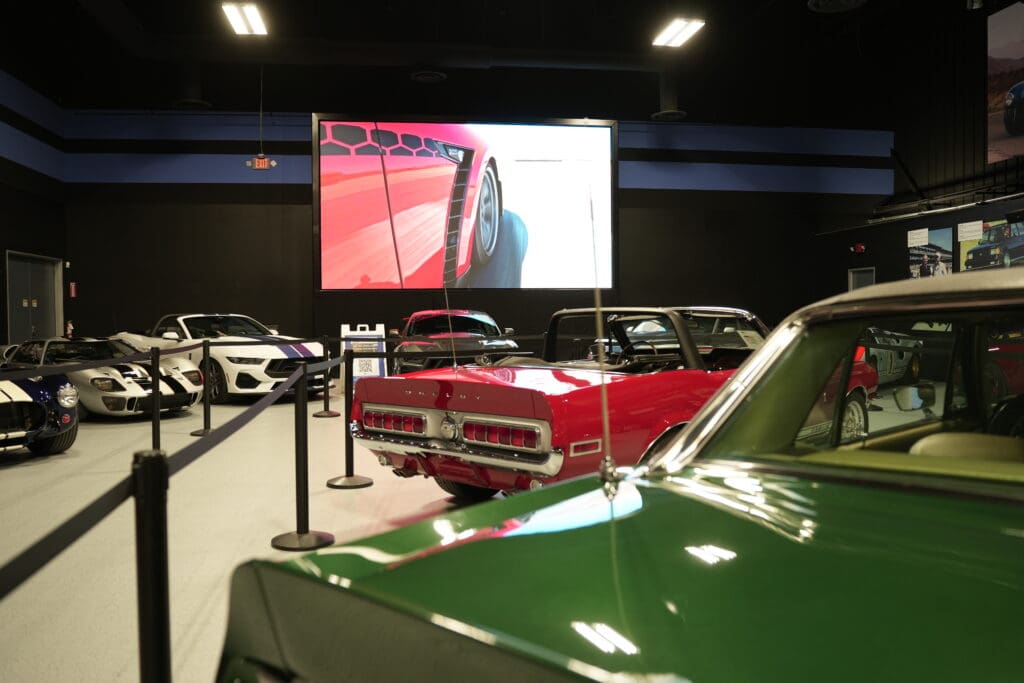
Shelby Heritage Center with LED display size appropriate for the space.

Step 2: Engineering and Design 

This is where a flat spec sheet turns into an actual plan for the space. For a curved or wrapped display, the substructure gets engineered and fabricated specifically for that install rather than adapted from a standard flat frame. PixelFLEX designed exactly this kind of custom substructure for NYCFC developed its Stadium Experience Center, where the client needed a seamless 90-degree curve radius that had to be planned around the architecture itself. Anything unusual about the space, load restrictions, historic preservation limits, tight access, gets engineered around at this stage, not discovered mid-install. 

Free-standing or sculptural displays add another layer to installation plans: where the power and data whip exits the base, and how it’s routed from there. Left uncoordinated with the architect, that cord can end up running exposed across a finished floor instead of hidden inside the structure. This can be an expensive problem to fix once the floor is installed. Planning cable paths with the architect at this stage is what keeps that whip hidden and the finished look clean. 

Step 3: Fabrication and Assembly

Panels and modules get built to the project’s exact specs, size, shape, and pixel pitch, rather than pulled from generic inventory. Curved and multi-surface designs need panel-to-panel tolerances tight enough that the seams don’t show through the curve once everything is mounted. 

Step 4: Quality Control Testing 

Every unit goes through quality testing before it ships. PixelFLEX runs every display through a 3-part quality control process, checking for consistent color, brightness, and function across every panel before it leaves for the job site. 

Step 5: Packaging and Shipping

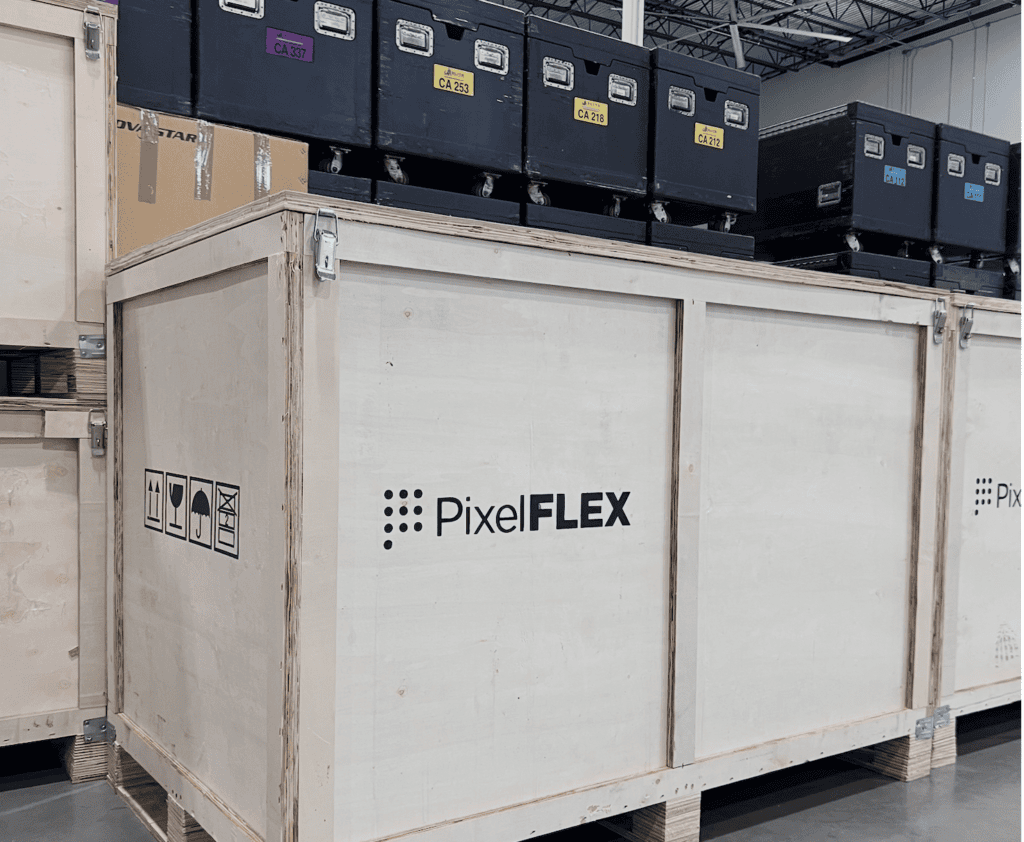
Custom panels get packaged to protect the exact shape and finish they were built with.

Curved or non-standard modules often need custom packaging rather than a standard shipping crate, since a generic box isn’t built to protect a shape that doesn’t match a flat panel.

LED display crates

Step 6: On-Site Installation and Calibration

Installation follows the site survey and structural plan from earlier stages. Once panels are mounted, they get calibrated and color-matched on-site so the display looks even from one panel to the next, the same step every corporate or custom install goes through before the crew leaves. 

The installation phase itself is covered in more depth in Working with an LED Display Supplier, During Installation. 

Frequently Asked Questions 

How long does custom LED display manufacturing take? 

Timelines vary based on size, shape, and complexity. 

A full breakdown of typical lead times is covered in What’s the typical lead time for a custom LED video wall build?. 

What makes custom LED manufacturing different from a standard display? 

A standard display comes from existing inventory built to common sizes and shapes. A custom display is engineered and fabricated around a specific space, size, shape, or pixel pitch that a standard product line doesn’t cover. 

Does every custom LED project need a structural engineer? 

Not every project, but any install into a non-standard space, a curved or suspended design, a historic building, or an unusual mounting surface, should have a structural engineer involved during the engineering and design stage. 

Can curved or oddly shaped LED displays be manufactured to match any space? 

In most cases, yes, but it takes a substructure engineered specifically for that shape rather than an adapted flat-panel design. The more unusual the space, the earlier that engineering work needs to start. 

Not Sure What Size Fits Your Space? 

Every custom build starts with the specifics of your space. Connect with our team to talk through what’s possible for yours. 

LED Wall vs. Projector for Boardrooms and Conference Rooms, Which Wins? 

LED is much better suited for most boardrooms and conference rooms, especially any space with windows or bright overhead lighting. A projector can still make sense for a lower-budget or rarely used rooms, but it gives up brightness and image clarity in the typical lighting conditions of most offices. 

The categories below cover where each technology actually wins, and where the right answer depends on the room. 

Written by Briton Roberts, PixelFLEX  with 7+ years at PixelFLEX across Technical Services, Product Management, and Engineering; 12+ years of soldering experience; has managed 1,000+ installations 

Brightness and Ambient Light: LED Wins 

LED holds full brightness and color regardless of the light in the room. A projector loses contrast fast under overhead lighting or daylight through windows, which is exactly the environment of most conference rooms. Dimming the room or closing blinds for every meeting isn’t a realistic ask, and it’s the single biggest reason boardrooms move away from projection.

Image Quality and Seamlessness: LED Wins 

A direct-view LED wall has no visible seams and holds sharp, even color edge to edge. A projector’s image quality depends heavily on the screen it’s projected onto, and image sharpness drops if the throw distance or angle isn’t close to ideal for the room’s layout. PixelFLEX installed a 1.5mm pixel pitch FLEXThin display at United Bank’s Morrowcroft office specifically for this kind of close-viewing meeting space, where sharp, even color at a few feet away mattered more than raw screen size.

Installation and Space Requirements: It Depends on the Room

A projector needs enough throw distance behind or above the audience and a dedicated screen, which isn’t always available in a smaller conference room. An LED wall mounts flat against a wall and doesn’t need throw distance at all, making it the easier fit for tighter rooms. A very large room with plenty of throw distance and a tight budget is where a projector still has a real space advantage. 

Maintenance and Long-Term Cost: LED Wins

A projector bulb dims over time and eventually needs replacing, an ongoing cost most buyers don’t budget for upfront. 

LED doesn’t have a bulb to replace and holds its brightness far longer over the life of the display.

Over a multi-year period, LED’s maintenance costs are typically lower even though the upfront investment is higher. 

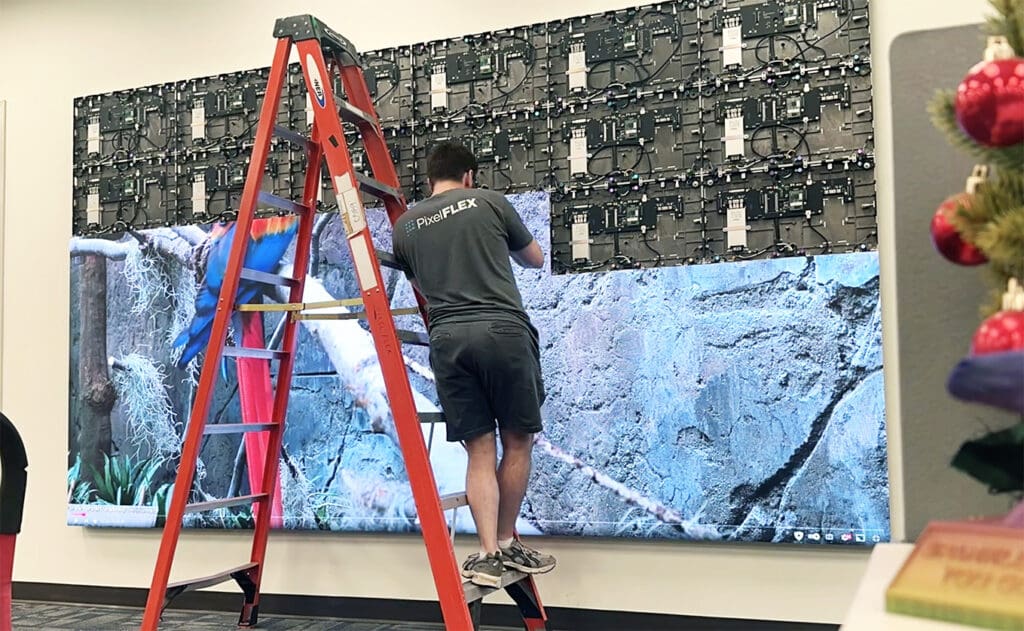
Briton Roberts installing smart pixel LED wall

Upfront Cost: Projector Wins

A projector is almost always cheaper to buy and install than an LED wall of the same size. For a rarely used room, a tight budget, or a temporary space, that upfront savings can outweigh LED’s other advantages. The math changes for a boardroom used daily, where LED’s lower long-term maintenance cost and better everyday image quality usually justify the higher initial price. 

So Which Actually Wins?

For a boardroom or conference room used regularly, especially one with windows or overhead lighting that can’t be fully controlled, LED is the better fit in nearly every case when deciding between a led wall vs projector. A projector still makes sense for an infrequently used space, a very large room with generous throw distance, or a tight budget where the upfront cost difference matters more than day-to-day image quality. 

Frequently Asked Questions 

Is an LED display more expensive than a projector for a conference room? 

Yes, upfront. LED costs more to purchase and install than a projector of similar size, but it typically costs less to maintain over several years since there’s no bulb to replace and brightness holds up longer. 

Does ambient light affect projector image quality? 

Yes, significantly. Overhead lighting or daylight through windows washes out contrast on a projected image. LED holds full brightness and color regardless of ambient light in the room. 

How long do LED displays last compared to projectors? 

LED displays hold their brightness for years longer than a projector bulb, which dims steadily and eventually needs replacing. LED has no bulb to replace at all. 

Is a projector ever still the right choice for a conference room? 

Yes. A large room with generous throw distance, an infrequently used space, or a tight budget are all situations where a projector’s lower upfront cost can outweigh LED’s advantages. 

Not Sure What Size Fits Your Space? 

The right answer depends on room size, lighting, and how often the space gets used. Connect with our team to talk through what’s possible for yours. 

What Size LED Video Wall Is Right for a Corporate Lobby? 

The right LED display size for a corporate lobby depends on the room’s proportions, the furthest realistic viewing distance, and the content the wall needs to show, not a single formula or a target square footage. Most lobby installations end up between 8 and 20 feet wide, but the room decides that number, not a chart or a rule of thumb. 

Written by Isaiah Snyder, Operations Manager at PixelFLEX with 10+ years in the AV industry, 8+ years focused on DVLED specifically; started in surface-mounted diode repair before moving into engineering LED hardware and software 

Start With the Room, Not a Target Size

Measure the wall space available first, then the floor space in front of it. A lobby with 30 feet of open floor in front of the wall supports a much larger LED display size than one where people pass within a few feet on their way to an elevator bank.

That measurement, more than any preset size chart, is what determines the right LED display size for a given space. 

Shelby Heritage Center with LED display size appropriate for the space.

Match the LED Display Size to Viewing Distance

Viewing distance and pixel pitch determine how large a wall can be before the image looks soft, or how small it needs to be before individual pixels become visible up close. A wall sized for a lobby where people walk within 5 feet needs a finer pixel pitch than one viewed from across a 40-foot atrium, and that pitch decision affects what size makes sense in the first place. 

The specific pitch math is covered in, What’s the ideal pixel pitch for a corporate lobby display viewed from 6-10 feet?. 

Account for the Content, Not Just the Wall 

A wall built to show full-screen video needs a standard aspect ratio like 16:9, and its dimensions should follow that ratio to avoid black bars or cropped content. A wall built mainly for branding, data dashboards, or a rotating mix of content has more flexibility, since a wider or taller shape can still work well if the content is designed for it. Decide what’s actually going to run on the wall before finalizing dimensions.

Curved and Non-Standard Lobbies Change the Math 

A curved or wraparound lobby wall doesn’t size the same way a flat wall does. PixelFLEX built an 18-fin curved display for NetApp’s headquarters lobby, wrapping the entrance into a single 360-degree focal point. That kind of layout is sized around the architecture itself, the fins and curve radius, rather than a flat width-by-height measurement, and it needs the display designer and the space’s architectural plans involved early. 

A Reference Point From the Field 

For scale, PixelFLEX installed a FLEXThin LED wall at United Bank’s Morrowcroft office with an LED display size that is  roughly 13 feet wide by 7 feet tall for a meeting space, a useful benchmark for a mid-size display viewed at close range.

A lobby wall meant to be seen from across a larger open area typically runs larger than that, since it has more room to work with and a longer viewing distance to design around. 

LED display size appropriate for corporate conference room with

Frequently Asked Questions 

What size LED video wall is right for a small corporate lobby? 

A smaller lobby with limited floor space in front of the wall generally works best with a display in the 6 to 10 foot wide range, paired with a finer pixel pitch since viewers will typically stand closer. 

Does a lobby LED wall need to match a 16:9 aspect ratio? 

Only if it will regularly show full-screen video content. A wall used mainly for branding or data doesn’t need to follow a standard aspect ratio and can be sized to fit the architecture instead. 

How far should people stand from a lobby LED video wall? 

It depends on pixel pitch, but most corporate lobby walls are designed around a closest viewing distance of 6 to 10 feet. Walls viewed from farther away can run a coarser pitch without any visible loss in quality. 

Can an LED video wall fit into an oddly shaped or narrow lobby? 

Yes. Curved, wrapped, and multi-surface designs can fit non-standard spaces, but they need to be engineered around the architecture from the start rather than adapted from a standard flat-panel layout after the fact. 

Not Sure What Size Fits Your Space? 

Every lobby is a different shape, with different foot traffic and viewing distances. [Contact PixelFLEX] to talk through your space before finalizing a size. 

Written by PixelFLEX – Trusted supplier of direct-view LED displays, backed by an in-house team of engineers, technical strategists, and installation specialists with decades of combined experience across the audio/visual industry 

A corporate video wall is a direct-view LED display installed inside a business environment, a lobby, boardroom, conference room, briefing center, or trading floor, to communicate branding, data, or content to employees, clients, and visitors. Unlike an outdoor display or a touring video wall, a corporate install is judged on how well it disappears into daily business use: even color from a few feet away, quiet operation, and content that a non-technical facilities or marketing team can update without calling in a technician every time. 

This guide covers what corporate LED displays are, where they show up inside a business, and the specs, cost drivers, and installation factors that matter most. It also links out to focused guides on sizing, pixel pitch, cost, content management, and manufacturer selection for anyone speccing a corporate project. 

What Counts as a Corporate Video Wall? 

A corporate video wall is any direct-view LED wall purchased and installed for a business’s internal or client-facing space, not a stadium, a retail storefront, or a touring rental rig. That distinction matters because corporate buyers optimize for different things than a venue or event client does. A stadium display is chosen for brightness and durability at distance. A corporate display is chosen for color accuracy up close, low noise, easy content updates, and a design that fits an architectural space rather than dominating it. 

Within that category, the most common formats an AV integrator will encounter are: 

  • Lobby and reception video walls, often the first thing a visitor sees when they walk in 
  • Boardroom and conference room displays, sized for close viewing during presentations and video calls 
  • Executive briefing centers and customer experience centers, built to impress clients touring a facility 
  • Trading floors, network operations centers (NOCs), and data-visualization walls 
  • Brand or story walls in common areas, hallways, and headquarters atriums 

Where Corporate Video Wall Displays Show Up in the Field

PixelFLEX has installed corporate LED displays across each of these formats, and the real-world specs tell you more than a spec sheet does. 

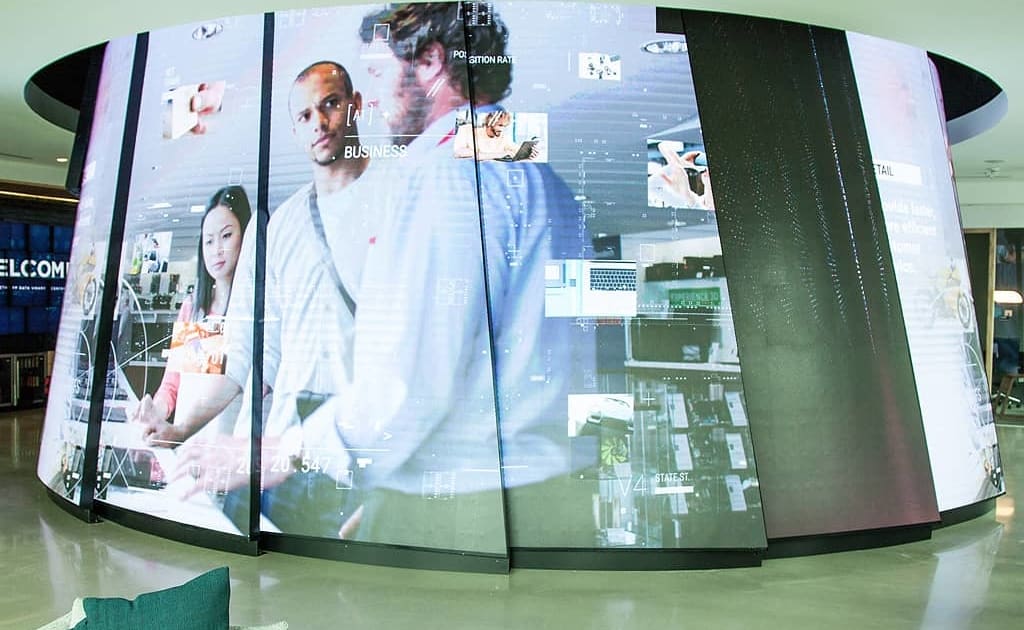
At NetApp’s revamped Silicon Valley headquarters, the entryway needed to double as a client-facing visualization center. The solution was a curved display built into 18 individual fins to create a seamless 360-degree focal point at the entrance, using FLEXMod panels.

This is a common pattern for corporate lobbies: a curved or wrapped display makes a stronger first impression than a flat wall and photographs better for recruiting and marketing content. 

At a worldwide technology leader’s Washington, D.C. headquarters, the client was replacing an outdated LCD monitor wall with a FLEXUltra LED display built with impact-resistant PixelShield, tied into a Crestron control system through a media server so content could shuffle across the wall on demand. Swapping LCD for LED in a high-traffic HQ hallway is one of the most common corporate upgrade paths, and it’s almost always driven by the same complaint: visible seams and inconsistent color on the old LCD array. 

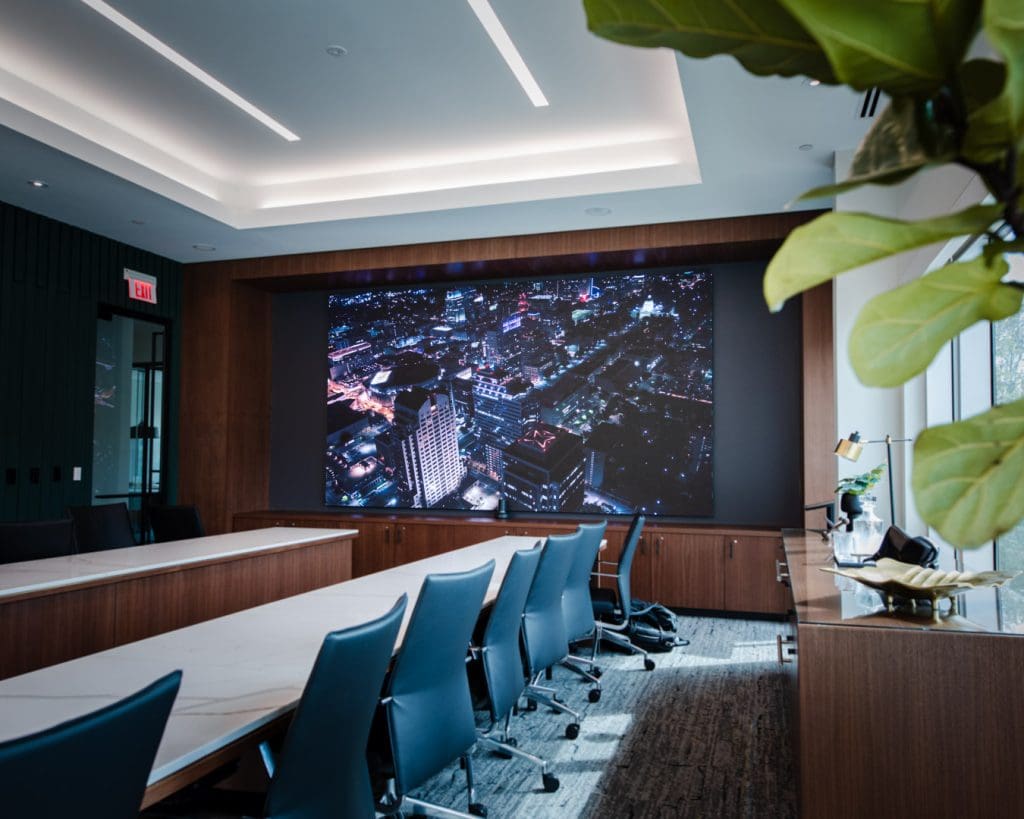
At United Bank’s Morrowcroft regional corporate office, the project was a meeting-space upgrade: a FLEXThin display at a 1.5mm pixel pitch, just over 13 feet wide by 7 feet tall, running on a Colorlight sending controller. That’s a good reference point for a boardroom or large conference room, close-viewing distance, fine pixel pitch, and a controller setup an in-house AV team can manage. 

At HINO Trucks’ U.S. headquarters, multiple corporate video wall displays (using FLEXTour) were installed as the centerpiece of their Connected Vehicle Department, paired with a real-time dashboard monitoring system so staff could track fleet data as it happened. This is the trading-floor or NOC use case: the display isn’t decoration, it’s a working operational tool. 

Pixel Pitch and Viewing Distance for Corporate Spaces

Pixel pitch should be chosen based on the closest distance someone will realistically stand from the display, not the room’s average distance. Corporate spaces cluster in the 1.2mm to 2.8mm range depending on the use case, boardrooms and close-viewing meeting spaces (like the 1.5mm United Bank install above) sit at the fine end, while lobby and hallway walls viewed from further back can run coarser without any visible loss in quality. 

A deeper breakdown of pixel pitch math and recommended distances can be found in this article. 

LED vs. Projector, LED vs. LCD for Corporate Environments 

LED outperforms both projectors and LCD video walls on ambient light handling and seamlessness, though projectors and LCD still have a place where budget or extreme resolution flexibility matters more than either of those. 

A projector loses contrast in a bright lobby or a conference room with windows, and it needs throw distance the room may not have. An LCD video wall holds color reasonably well but always has visible bezels between panels, which is precisely the complaint that drove the Washington, D.C. headquarters upgrade above from an LCD monitor wall to seamless LED. Direct-view LED avoids both problems: no visible seams, and full brightness and color control regardless of ambient light. The tradeoff is upfront cost per square foot, which is where a clear conversation about total cost of ownership, not just purchase price, matters. 

See LED display vs. projector for boardrooms and conference rooms, which wins? for a full head-to-head. 

Content and Control: What Runs on a Corporate Video Wall 

The right content management setup matches the software to whoever is actually going to update the display day to day, usually a facilities or marketing team, not an AV specialist. 

Corporate LED content typically runs through a media server or dedicated content management software tied into the building’s existing AV control system. In the D.C. headquarters install above, content ran through a media server connected to a Crestron system, which let staff reshuffle content without needing a technician on-site every time messaging changed. That’s the standard a corporate buyer should expect: scheduled content, easy swaps for new branding or announcements, and integration with whatever control platform (Crestron, AMX, or similar) the building already uses. 
A full comparison of content management platforms is covered in: What content management software works best for corporate lobby displays?. 

Cost and Budgeting for a Corporate LED Video Wall

PixelFLEX has installed corporate LED displays across each of these formats, and the real-world specs tell you more than a spec sheet does. 

The biggest cost drivers, in rough order of impact, are pixel pitch (finer pitch costs more per square foot), whether the design is flat or curved (curved and wrapped installs like NetApp’s 18-fin entrance need custom substructure fabrication), the control and content system tied into the wall, and the complexity of the install itself (a historic building or a non-standard ceiling adds engineering time before a single panel goes up).

Purchase price is only part of the real cost; warranty coverage, spare-parts planning, and repair turnaround affect total cost of ownership over the life of the wall. 

For a detailed cost walkthrough, see How much does a corporate LED video wall cost, installed? (to be posted soon). 

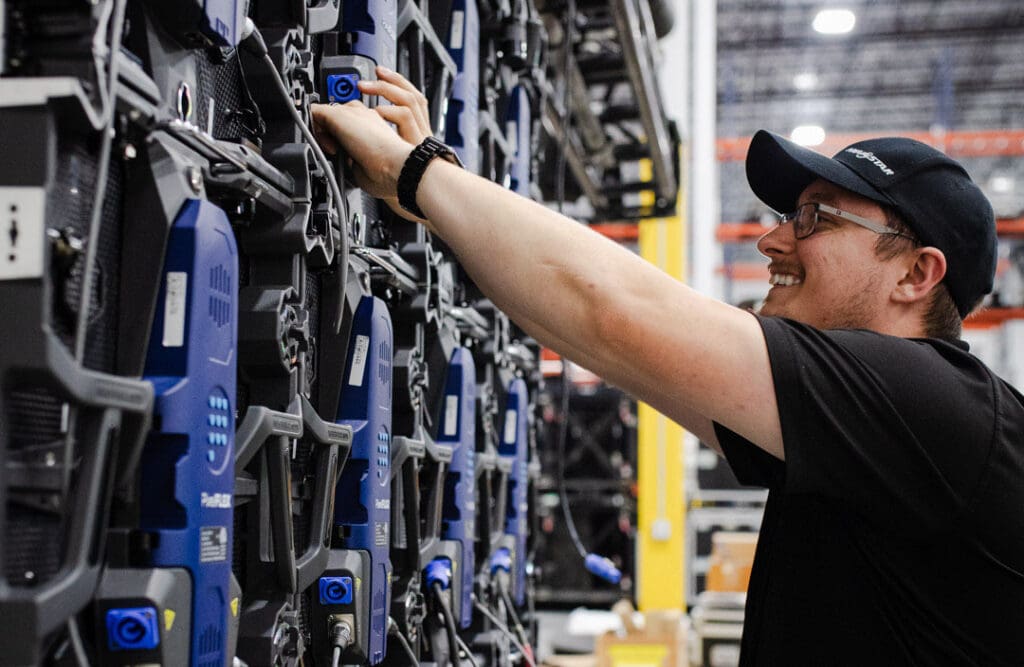
PixelFLEX LED technician building LED wall

Structural and Design Considerations for Corporate Installs 

Curved, wrapped, or non-standard corporate installs need the mounting substructure engineered specifically for that display, not adapted from a flat frame after the fact, and any project inside a historic or architecturally constrained building needs a structural engineer involved before the display design is finalized. 

Corporate lobbies and headquarters buildings are some of the least standardized spaces an integrator will work in. A curved entrance display, like NetApp’s 18-fin wraparound wall, only looks seamless if the substructure is fabricated to tight tolerances up front. A renovated or historic headquarters building may carry load and preservation restrictions that dictate exactly how and where a display can be suspended or mounted. Getting a structural engineer and the display designer talking early avoids the costly rework of retrofitting a design around constraints that were known from day one. 

What to Expect Working With a Manufacturer, Before, During, and After Install 

Corporate buyers rarely evaluate LED manufacturers on the display alone. The bigger differentiator is what happens before the design is finalized, during the install itself, and in the years after the wall goes live. Every PixelFLEX installation includes a standard 3-year warranty (with additional years available), and every unit passes a 3-party quality control process before it reaches the customer, standards worth asking about with any manufacturer you’re evaluating. 

This full customer journey, what to ask before you buy, what to expect on install day, and how to plan for service after, is covered in the companion pillar article, Working with an LED Display Provider. 

Explore the Corporate LED Display Series 

Each guide below goes deep on one specific question. Links will go live as each post publishes. 

Frequently Asked Questions 

What are corporate video walls used for? 

Corporate video walls communicate branding, data, and content to employees, clients, and visitors in lobbies, boardrooms, conference rooms, briefing centers, and trading floors. The use case, client-facing versus operational, drives most of the design decisions that follow. 

Is LED better than LCD for a corporate video wall? 

For most corporate applications, yes. LED avoids the visible bezels between panels that LCD video walls always have, and it holds color and brightness consistently regardless of ambient light, which is why several corporate upgrades replace an existing LCD wall rather than starting from scratch. 

How do I know what size LED display my corporate space needs? 
Size depends on viewing distance and pixel pitch together, not square footage alone. A boardroom viewed from a few feet needs a fine pixel pitch at a modest size, while a lobby wall viewed from across a room can run larger at a coarser pitch without losing image quality. 

Want help thinking through the structural or mounting side of your next DVLED install? We would love to connect with your team to talk through your specific space before you finalize the design. Schedule a project consultation today.

Overcoming Common Challenges When Specifying LED Displays in Architecture Projects

Architectural design has always been about vision — shaping spaces that connect with people through form, function, and feeling. In recent years, LED displays have become a powerful part of that vision. From a massive exterior video wall that turns a building into a nighttime landmark to a subtle, dynamic lobby installation that changes the mood of a space, LED technology has expanded what’s possible in the built environment.

But as exciting as these possibilities are, translating them from concept to completion can be far from simple. The creative ideas that seem limitless in the design phase can meet roadblocks in engineering, compliance, or installation. Technical missteps, late-stage compromises, and communication gaps can dilute the original design intent — or worse, prevent the project from moving forward at all.

At PixelFLEX LED, we believe that technology should serve the vision, not limit it. The most compelling architectural LED integrations happen when creative ambition is paired with technical precision from day one. Here’s how that happens, and how the most common hurdles can be transformed into opportunities for stronger design.

Bringing Technology Into the Design Conversation Early

One of the most common issues we see is LED being treated as an add-on rather than an integrated design element. When the decision to include a display happens late in the process, the architectural space has often already been planned without accounting for its structural, electrical, and environmental needs.

This can lead to rushed compromises — reducing display size to fit into an existing wall opening, accepting visible seams where none were intended, or choosing a mounting method that disrupts the design language.

The solution is simple but often overlooked: bring the LED conversation into the earliest stages of design. When architects, engineers, and LED specialists collaborate from the start, the result is not just better integration, it’s a display that feels native to the architecture. In one corporate project, early planning allowed the design team to recess a large-scale display into a custom feature wall, hiding all technical components while preserving the clean sightlines of the lobby. Without that early involvement, the display would have required a bulky surface mount that would have disrupted the space’s minimal aesthetic.

Translating Technical Complexity Into Design Confidence

Architects are experts in spatial vision, not in calculating the power distribution for thousands of LED modules or planning ventilation for high-performance electronics. Yet these technical factors — along with structural loads, weatherproofing, and heat management — can make or break an installation.

Too often, the technical information architects receive from vendors is either incomplete or overly dense. It becomes another barrier in the design process, making it difficult to confidently specify a product or finalize details with contractors.

The answer isn’t to expect architects to become LED engineers, it’s to translate complex requirements into clear, actionable design information. For a recent public plaza project, our team provided fully scaled engineering diagrams that overlaid display specifications onto the architect’s own CAD drawings. This made it easy for the design team to see exactly how the display would interact with surrounding materials, where structural reinforcement would be needed, and how to plan routing for power and data — without ever feeling like they were reading a technical manual.

Bridging the Gap Between Design and Implementation

Even when the design and technical specs are perfect on paper, the project can falter if communication breaks down between the architect, LED manufacturer, AV integrator, and contractors. Misunderstandings about mounting details, ventilation clearances, or even the intended resolution of the display can lead to costly delays.

We’ve seen this avoided through deliberate project management and cross-discipline coordination. In one museum installation, our role went beyond supplying the LED system — we attended construction meetings, reviewed mock-ups, and worked directly with millworkers to ensure the display enclosure matched the surrounding finishes exactly. By acting as the bridge between creative and technical teams, we kept the installation on schedule and preserved every detail of the original design intent.

Balancing Creativity With Code Compliance

Pushing creative boundaries is part of every great architectural project — but it can’t come at the cost of safety, accessibility, or regulatory compliance. For LED displays, these considerations extend beyond the obvious. They can include weight limits for suspended elements, ADA standards for viewing angles and placement, and even ventilation requirements tied to electrical code.

Addressing these factors late in the process can lead to last-minute redesigns that strip away the essence of the original concept. Addressing them from the start makes them part of the creative solution.

On a large-scale exterior installation, our team worked with both the architect and the local permitting office before fabrication began. By presenting detailed mounting specs, wind-load calculations, and heat dissipation data, we secured approvals without altering the display’s footprint or brightness. The result met both the creative vision and the most rigorous safety standards — a win for design and compliance alike.

Customizing LED to the Architecture, Not the Other Way Around

One of the fastest ways to lose the integrity of a design is to force it to fit a pre-made display format. Standard LED panels may work for conventional installations, but architectural projects often demand more — unique dimensions, curved surfaces, or unusual mounting conditions.

Rather than reshaping the design to accommodate the technology, the technology can be reshaped to serve the design. In a performing arts center project, we created a series of custom LED panels to match the curve and taper of an existing architectural feature. Each panel was built to exact dimensions, allowing the display to read as part of the building rather than an added object.

Custom solutions like this not only preserve the design language but also open creative possibilities that would be impossible with off-the-shelf components.

From Challenge to Opportunity

The truth is, every architectural LED project will have challenges. The question is whether they are discovered early enough to be solved without compromise. With the right partnership, each challenge becomes an opportunity to refine and strengthen the design.

By engaging LED specialists early, translating technical requirements into clear design actions, coordinating across disciplines, addressing compliance proactively, and customizing the technology to the architecture, architects can design with confidence — knowing their vision will survive the journey from concept to completion.

Designing With Confidence

At PixelFLEX LED, our role is to remove barriers between an architect’s idea and its execution. We provide not just the technology, but the collaboration, communication, and customization that ensure LED integration serves the architecture at every stage.

From the first sketch to the final inspection, we’re committed to making LED a medium that enhances your design without limiting it. With every project, our goal is the same: to see your creative intent not just survive the process, but emerge stronger because of it.

Explore our LED display solutions | See our case studies | Start a partnership with PixelFLEX LED

Creating Unforgettable Visual Impact with LED Displays

In the world of live event production, there’s one truth every producer knows: people might forget what they heard, but they’ll never forget what they saw. Visuals have the power to capture attention instantly, shape the audience’s mood, and burn a lasting impression into memory. In today’s competitive landscape, where events are competing not just with each other but with the constant noise of digital content, the visual component isn’t just important; it’s everything.

At PixelFLEX LED, we’ve seen firsthand how the right LED display can transform a space from functional to breathtaking. From music festivals that draw thousands to corporate conferences that need a polished, high-end presence, LED displays have become the foundation of creating immersive, attention-commanding experiences. This blog focuses on one thing: visual impact, and how to design it, deliver it, and make sure it lasts far beyond the final curtain call.

The Power of Instant Attention

In live events, the first few seconds matter most. As soon as the audience walks in, you’re competing with dozens of distractions—conversations, mobile phones, the logistics of getting seated or finding a spot. A static backdrop or basic projection might fill space, but it rarely demands focus.

LED displays have the unique ability to dominate attention immediately. High-resolution panels render vivid colors, deep contrasts, and sharp imagery that stand out in even the brightest lighting conditions. From the back row to the front, the visual clarity draws people in and tells them something important is happening.

We’ve worked with event producers who’ve seen the mood of a room shift the second the LED wall comes alive. The energy rises, conversations pause, and the crowd leans in. That’s the kind of moment you can only create with powerful, high-quality visuals.

Designing Visuals That Tell a Story

The best event visuals aren’t just decorative; they’re narrative. They set the tone, support the theme, and guide the audience’s emotional journey from start to finish. A concert might use LED panels to pulse and shift in sync with the music, while a product launch could use them to unveil new features with dramatic animations that build suspense.

With LED technology, you’re not limited to a single static image or pre-rendered video loop. Content can be dynamic, adaptive, and reactive—changing throughout the event to keep the audience engaged. That flexibility allows you to create layers of storytelling, revealing new visuals as the event unfolds.

We often collaborate with creative teams to design visuals that blend seamlessly with lighting design, stage architecture, and live camera feeds. When all these elements work together, the LED display stops feeling like technology and starts feeling like part of the environment—a living, breathing component of the production.

Immersive Experiences That Surround the Audience

One of the most exciting aspects of modern LED technology is its ability to break out of the traditional rectangular frame. With flexible, curved, and modular panel designs, LED displays can wrap around the stage, form ceiling installations, or even create 360-degree environments.

For example, at a large-scale brand event, we helped design an LED installation that extended from the stage up onto the ceiling, creating a visual dome effect over the audience. The result was an environment that didn’t just display visuals—it transported attendees into an entirely different world.

Immersion is the difference between a good show and an unforgettable one. When the visuals are everywhere, not just in front of you, they become part of the physical space, shaping how people feel and interact with the event.

Making Every Seat the Best Seat in the House

One of the biggest challenges in event production is ensuring that everyone in the venue gets the same quality of experience. In large spaces, projection screens can wash out or lose clarity, especially for those seated far from the stage. LED displays eliminate that problem. Thanks to high brightness, wide viewing angles, and scalable sizing, LED walls deliver consistent image quality from every vantage point. Even in direct sunlight at outdoor events, content remains sharp and vibrant. That consistency ensures every attendee feels equally engaged, no matter where they’re standing or sitting.

Creating Moments Worth Sharing

In today’s social media-driven culture, visual impact isn’t just for the people in the room—it’s for everyone who sees the photos, videos, and clips that get shared afterward. The most powerful event visuals are the ones that make people reach for their phones without thinking.

We’ve seen this happen time and again: a stunning stage backdrop becomes the most-photographed element of an event, or a dramatic visual reveal gets replayed across social channels for days. These moments create organic marketing reach, turning attendees into brand ambassadors without a single paid ad.

When you design with this in mind—framing certain moments for maximum shareability—you extend the life and impact of your visuals far beyond the event itself.

Integrating Visuals Seamlessly into the Production

The most impressive LED displays don’t stand out because they’re big; they stand out because they feel like they belong. A screen that looks bolted on at the last minute can be distracting and take away from the production’s polish.

At PixelFLEX LED, we approach every project with integration in mind. From the earliest stages of planning, we work with producers, stage designers, and content creators to ensure the LED solution fits naturally into the event’s overall look. Whether that means matching scenic elements, concealing rigging, or shaping panels to fit unconventional designs, the goal is to make the technology disappear so the visuals can shine.

Balancing Impact with Practicality

While this blog focuses on visual power, we know that great visuals still need to be practical to execute. That means ensuring that the design can be loaded in and out efficiently, fits within the technical constraints of the venue, and works flawlessly under show conditions. In the context of visual design, this practicality translates into predictability—the confidence that your visuals will deliver exactly as planned when the lights go down.

Why PixelFLEX LED for Event Visuals

We’re not just LED suppliers; we’re collaborators. We understand that for event producers, the stakes are high. You’re putting your name on the line every time you take on a project, and your visuals are often the most visible part of the production.

Our role is to make sure you can deliver on your creative vision without compromise. We combine advanced LED technology with hands-on production support to give you a solution that looks spectacular and performs flawlessly.

From concept to content to execution, we’re there every step of the way to make sure your event doesn’t just look good—it looks unforgettable.

Ready to Deliver the Most Visually Striking Event of Your Career?

Let’s design an LED display that doesn’t just support your production—it steals the show.

Explore our LED display solutions | See our case studies | Start a partnership with PixelFLEX LED

Making Your Advertising Dollars Go Further with LED Displays

Advertising is an investment. Yet for many businesses, it often feels like a gamble. Money goes out, but the returns are hazy. Billboards fade into the background, print ads are glanced at and tossed aside, and digital campaigns disappear in the endless scroll of social feeds. Too often, you’re left wondering whether anyone even saw your message, let alone acted on it.

It’s no secret that advertising today must do more than just be present; it should demand attention, spark curiosity, and drive measurable results. That’s where LED display technology changes the game. In today’s crowded marketplace, where consumers are bombarded with messages every second, LED displays don’t just compete for attention—they command it.

Why LED Displays Are the Future of Advertising

The truth is that traditional advertising formats are struggling to keep pace with our fast-moving, visually driven world. A static sign might catch a passerby’s eye for a second, but it can’t adapt to the moment. LED video walls, on the other hand, bring motion, light, and color together to create bold, dynamic messages that connect with any audience.

Whether it’s an outdoor LED display screen lighting up a busy intersection or an indoor LED solution captivating shoppers in a retail space, LED video screens work harder and smarter than static options. They deliver visual impact that grabs attention instantly and keeps working long after other advertising mediums have gone stale.

And it’s not just about looking good. It’s about being strategic. LED displays let you control your message in real time. You can update promotions instantly, respond to trends, and tailor content to the audience right in front of you. The result? Your campaigns stay fresh, relevant, and engaging, without the ongoing costs of reprinting, replacing, or redistributing traditional signage.

Stretching Your Budget with Smarter Technology

Every marketing dollar matters. You need to know that your investment is working hard for you. LED technology helps you do more with less by eliminating the need for multiple signs, ad placements, or repeated print runs. Instead, you can rotate and schedule multiple messages on a single display, maximizing visibility without increasing costs.

A restaurant can advertise breakfast specials in the morning, happy hour deals in the evening, and weekend events after dark—all on the same screen, without ever touching a printing press. A retail store can showcase seasonal sales in real time, switching from summer clearance to back-to-school promotions instantly.

With the flexibility to change content in the moment, you’re able to keep messaging timely, relevant, and aligned with customer needs, without waiting for new materials to be produced. The ability to adapt quickly means you can respond to trends, highlight new offers, and maintain a consistent presence that keeps audiences engaged.

Tailored to Your Brand and Space

No two businesses or budgets are the same, which is why cookie-cutter solutions rarely deliver the best results. At PixelFLEX LED, we design custom LED displays for venues of all shapes and sizes.

For some clients, that means a massive outdoor screen that dominates a city block and reaches thousands of viewers every day. For others, it’s a sleek, interactive LED installation inside a retail environment that creates an intimate and memorable customer experience. The goal is always the same: deliver maximum impact while respecting your budget.

Every display we build is designed to amplify your brand without unnecessary costs or compromises. We factor in your space, audience, and objectives to create a solution that feels like it was built for you—because it was.

Bringing Creativity to Life

Advertising has always been about more than selling a product; it’s about telling a story. The most effective campaigns make people stop, think, and feel something. LED displays give you a vibrant, flexible canvas to tell that story in ways static media never could.

With high-resolution visuals, seamless video playback, and the ability to integrate interactive elements, LED displays turn your vision into an experience. Imagine transforming your storefront into an immersive brand showcase, where passersby can interact with your message and become part of your story.

We’ve seen it happen firsthand. One of our retail clients transformed their entryway into an interactive brand hub, encouraging customers to engage with the display before they even stepped inside. The result wasn’t just more foot traffic—it was a stronger emotional connection between the brand and its audience.

Maximizing Impact, Minimizing Waste

For decades, businesses have paid premium prices for billboard space, only to have their message overlooked by a majority of drivers and pedestrians. LED advertising eliminates that guesswork. You take control of your message. You decide when and how it appears. You adjust your content instantly, ensuring every impression counts.

This flexibility means you’re not just broadcasting blindly—you’re delivering targeted, time-sensitive promotions without added costs. If the weather changes, your content can change with it. If a product sells out, you can switch the ad instantly. This level of agility makes your marketing more efficient, more effective, and far more adaptable than traditional channels.

Measuring Real ROI

The beauty of LED advertising is that it’s not just visually impactful—it’s measurable. Unlike traditional print ads, where tracking results can be murky at best, LED campaigns can be tied to clear performance metrics. You can track foot traffic before and after display installation, measure sales lift during specific campaigns, and gather data on customer engagement.

That means you can continually refine your approach, doubling down on what works and adjusting what doesn’t. Over time, this creates a compounding effect—each campaign becomes more targeted, more efficient, and more profitable.

Ready to Elevate Your Advertising?

If you’re looking for the best LED display for advertising—one that delivers measurable results and elevates your brand presence—PixelFLEX LED is ready to help. We’ll guide you through every step, from concept to installation, to ensure your investment works as hard as you do.

In a world where attention is the most valuable currency, you can’t afford to waste your advertising dollars on media that fails to connect. With LED display technology, your message isn’t just seen—it’s remembered, acted upon, and tied directly to your bottom line.

Explore our LED display solutions | See our case studies | Start a partnership with PixelFLEX LED

Adaptive Architecture: Why LED Displays Are the Next Frontier in Design

Modern architecture is no longer confined to fixed forms and static surfaces. It thrives on innovation, on pushing past boundaries where design, function, and experience merge to create spaces that communicate, adapt, and inspire. The most forward-thinking structures are more than places to inhabit; they are living expressions of vision.

Architectural LED display technology has become a powerful medium for integrating creative elements into a space. It gives architects the freedom to move beyond traditional limitations, transforming buildings into dynamic visual statements that shift, respond, and evolve. Far from being an afterthought, LED has emerged as a design element in its own right, one that can be woven seamlessly into the very fabric of a building.

This is the story of how LED displays empower architects to merge light, motion, and interactivity with architectural form that supports both bold creative ideas and lasting functionality.


Design Beyond Static Boundaries

In the past, buildings were defined by their physical structure. Facades, surfaces, and shapes were fixed once construction was complete. Today, LED displays allow those same surfaces to become active components of a design that can tell a story, shifting with the environment, and evolving with time. 

Instead of relying solely on static materials, architects can now integrate dynamic content into their structures. A glass curtain wall can transform into a living canvas for digital art. A corporate headquarters can feature a façade that evolves with the brand’s seasonal campaigns. Public installations can invite interaction that spark curiosity and draw people closer. 

Creating Architecture That Adapts Over Time

One of the most powerful benefits of LED in architectural design is adaptability. Buildings rarely serve the same purpose for decades without change. Tenants come and go, brands evolve, cultural priorities shift. Static signage or fixed decorative elements can quickly feel dated, requiring costly renovations to stay relevant. 

LED changes that equation by enabling content to evolve instantly without altering the structure. A retail flagship can refresh its storefront every month to reflect new product launches. A stadium can adapt its look for different sports seasons, community events, or cultural celebrations. A corporate lobby can integrate real-time data visualizations, shifting to reflect company milestones or live market conditions. 

This adaptability not only extends the relevance of a design but also makes it a responsive part of the urban environment. A building no longer must remain visually static; it can breathe with the city around it. 

Elevating the User Experience

Architecture has always been about more than form, it is about how people experience a space. LED displays open new possibilities for guiding, informing, and delighting users without disrupting a building’s aesthetics.

Consider a transit hub where dynamic LED wayfinding shifts in response to passenger flow, directing people toward less congested exits. Or a cultural venue where subtle, color-shifting installations help visitors intuitively navigate through galleries. Even safety cues, such as soft pulsing lights indicating emergency routes, can be integrated without breaking the visual harmony of the architecture.

These design choices enhance usability while maintaining visual integrity. They invite interaction not as a distraction, but as a natural part of the journey through the space.

Blurring the Line Between Inside and Out

Today’s architecture often seeks to create a sense of continuity between interior and exterior environments. Transparent and weather-rated LED technologies now make it possible to extend a design language seamlessly across both.

A glass façade can carry animated patterns during the evening while remaining clear and light-filled during the day. A semi-transparent LED mesh can give depth and dimension to a lobby, acting as a bridge between the public view outside and the private environment within. Outdoor LED installations can be integrated into landscaping, allowing buildings and their surroundings to share a single narrative.

The result is an architectural story that flows naturally from the street to the interior. It is an experience that feels cohesive, intentional, and immersive.

The Rise of Responsive, Intelligent Architecture

As smart building technology advances, LED displays are becoming part of a larger ecosystem of responsive design. The next generation of architectural LED is not just visually impressive, it is intelligent.

Imagine a façade that changes color temperature based on the time of day, complementing natural light cycles. Or a civic building whose exterior illuminates with data visualizations reflecting community initiatives or environmental metrics. Public installations can be activated by human presence, responding to motion, touch, or even sound.

These capabilities open new creative avenues while also supporting sustainability goals. Energy usage can be optimized through sensors that adjust brightness in response to ambient light or weather conditions. Content can be programmed to run at lower intensity during off-peak hours, reducing environmental impact without sacrificing visual effect.

A Collaborative Process with Architects

Technology alone does not create great design. The best results come from collaboration, where architectural vision and LED expertise intersect. At PixelFLEX LED, we see ourselves as partners in the design process, working with architects from the earliest concept stages to ensure that LED is integrated seamlessly, both visually and structurally.

That collaboration might mean engineering a custom display system to fit an unconventional building form. It might involve providing detailed specifications so that structural, electrical, and content requirements align perfectly before construction begins. It often means brainstorming creative ways to use LED not just as signage, but as a living part of the building’s identity.

Every project is a balance of imagination and precision. Our role is to provide the technical foundation that allows architects to think freely, knowing that their ideas can be executed reliably and beautifully.

Design Without Limits

Architectural LED displays are reshaping the way we think about space, structure, and storytelling. They offer architects a living medium, one that can be molded, animated, and reimagined without tearing down walls or starting from scratch.

Whether your vision is a kinetic façade, a multi-sensory interior environment, or a design that evolves with the seasons, LED technology can make it possible. More than that, it can ensure your work remains relevant and impactful for years to come.

At PixelFLEX LED, we believe in architecture without limits. And with LED, those limits are disappearing faster than ever.

Explore our LED display solutions | See our case studies | Start a partnership with PixelFLEX LED

The Partnership Advantage: How AV Integrators Win by Partnering With a Dedicated LED Display Provider

In the AV industry, success isn’t just about the technology you deliver—it’s about the partnerships you build along the way. For AV integrators, having the right LED display partner can mean the difference between winning a competitive bid and losing it to someone with faster, more reliable solutions. 

Why Partnerships Matter in Today's AV Market

AV integrators are navigating a market that’s more competitive than ever. Clients are asking tougher questions about ROI, sustainability, and scalability. Timelines are tightening. And the demand for unique, high-impact visual solutions is only increasing.

Going it alone means taking on all the technical, logistical, and creative challenges yourself. But with the right partner, you can expand your capabilities without increasing overhead, allowing you to focus on your clients while we handle the heavy lifting on LED design, engineering, and support.

Partnerships also help you respond to opportunities faster. When a client needs a custom LED solution on a short timeline, having a partner that already understands your process and has a proven track record with you can make the difference between landing the job and missing out.

What to look for in an LED Partner

Not all LED manufacturers or resellers operate the same way, and not all are a good fit for AV integrators. When evaluating a potential LED partner, consider:

Experience with Complex Projects – Have they delivered projects similar in size, scope, and technical complexity to what you’re bidding on?

Customization Capabilities – Can they provide solutions built to your exact dimensions and specifications, or are you forced into one-size-fits-all products?

Pre and Post Sale Support – Do they offer engineering assistance, site-specific documentation, and technical help after installation, or do they disappear once the product ships?

Proven Reliability – Can they back up their performance claims with real-world case studies and client references?

PixelFLEX was built with these criteria in mind. We’ve supported integrators on everything from flagship corporate installations to large-scale sports venues, ensuring they had the confidence to present bold solutions to their clients.

What PixelFLEX Brings to the Table for AV Integrators

When you partner with PixelFLEX, you gain access to a team that understands the pressures you’re under and has the tools to make your projects run more smoothly. Our custom LED display solutions are built to meet your exact project requirements, whether you’re installing a curved lobby wall, an outdoor scoreboard, or a modular video wall for a retail space.

Every project starts with a collaborative design process. We work with your team to create detailed engineering documentation, from load calculations to power requirements, so there are no surprises on site. Our renderings and visual mockups help you win client buy-in early, while our US-based technical support ensures you have a direct line to answers whenever you need them.

Growing Your Business Through Partnership

Partnership isn’t just about delivering a single successful project—it’s about building a foundation for future growth. Many of our AV integrator partners have used PixelFLEX LED solutions to expand into new markets, from live events and broadcast studios to large-scale architectural installations.

Because we understand the nuances of different applications, we can guide you toward the right products, features, and configurations for each project type. That means you’re never guessing—you’re presenting solutions that are technically sound, visually impressive, and built to last.

Partnership also strengthens your proposals. Having detailed engineering drawings, realistic renderings, and technical validation from a trusted vendor can help you win competitive bids and stand out in a crowded field.

Common Pitfalls AV Integrators Face Without a Partnership

Trying to manage every aspect of an LED installation without a trusted partner can lead to problems that hurt both your profit margin and your reputation. Some of the most common issues we’ve seen include:

  • Inaccurate specifications: Without precise load calculations, pixel pitch recommendations, and power requirements, you risk costly rework and change orders.

  • Delayed timelines: Lead times can stretch when product customization or site planning isn’t handled early, causing you to miss client deadlines.

  • Mismatch between product and environment: Using the wrong LED technology for the space can result in poor performance, reduced lifespan, or excessive maintenance.

  • Lack of technical support: When problems arise on site, having no one to call can stall your project and frustrate your client.

A strong partnership eliminates these risks by aligning your technical needs with proven solutions and giving you access to support whenever you need it.

Earning Long-Term Client Loyalty

In the AV world, your reputation is everything. When your projects are delivered on time, on budget, and to spec, you build trust that turns first-time clients into long-term partners. PixelFLEX is committed to helping you create those positive client experiences.

Our role is to make sure the LED portion of your project is never the bottleneck. From pre-sale engineering support to post-install maintenance resources, we’re here to ensure that your clients see you as a problem-solver and an expert, not just another vendor.

This is how AV integrators transform a single project into an ongoing relationship, with clients returning for upgrades, expansions, and new installations for years to come.

Partner with PixelFLEX LED

The right partnership can give you a competitive edge, expand your capabilities, and help you deliver results that keep clients coming back. With PixelFLEX LED, you gain a team that’s as invested in your success as you are—ready to collaborate, problem-solve, and deliver outstanding LED display solutions for any environment.

Explore our LED display solutions | See our case studies | Start a partnership with PixelFLEX LED

×
Need Help?
X

Ready to Talk?

Our team is ready to connect.