 (800) 930-7954

 House of Worship
 Transportation
 Trade shows led display
 retail
 Creative Led Solutions
 Hospitality
 Higher Education
 Corporate LED











Written by Briton Roberts, Sales and Product Engineer at PixelFLEX with 7+ years at PixelFLEX across Technical Services, Product Management, and Engineering that has managed 1,000+ installations
Direct-view LED keeps winning ground from projection, but real-world LED display installation problems are where good specs meet the real world of a jobsite. Cabinets that look perfect on paper still have to survive a historic building’s load limits, an interior corner that isn’t quite square, or a control room three floors away. Here are five problems we’ve run into in the field, and what actually solved them.
Problem 1: Structural Load Constraints in Non-Standard Spaces
The solution: When a space wasn’t built with LED in mind, whether that’s a historic building, a suspended install, or a non-standard ceiling, get a structural engineer involved before the display design is finalized, not after.
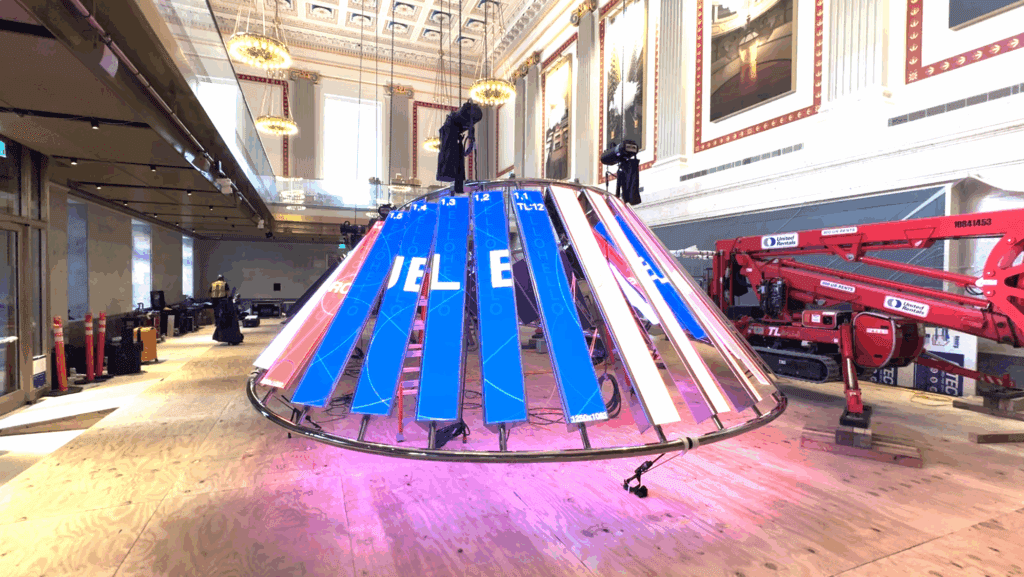
Not every install goes into a steel-frame commercial box. On our Milken Institute project, we partnered with an AV integrator to suspend an interactive LED sculpture 45 feet above a historic lobby, and the building’s preservation status meant strict load and suspension limits from day one. Every connection method and cable route had to be planned around what the structure could actually bear, not just what the design called for.
The building had recently undergone a careful renovation, and its ornamental floor design couldn’t be marked or damaged during the install. To solve this, the team built a temporary suspended floor directly over the decorative flooring and used specially sized boom lifts to safely reach the 45-foot install height, protecting the finished space while still getting the access the job required.
Problem 2: Mounting Tolerance on Curved and Corner Installs
The solution: Curved installs need the mounting substructure engineered and fabricated specifically for the display, not adapted from a standard flat frame after the fact.
Curved and wrap-around installs look seamless to the client, but getting there means the substructure has to be precise enough that panel-to-panel gaps don’t telegraph through the curve.
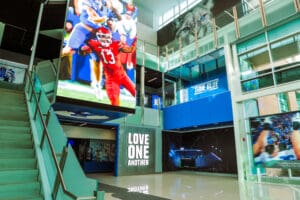
On the NYCFC Stadium Experience Center project, we mounted 490 FLEXMod panels (1.6mm pixel pitch) across two adjacent walls to form one continuous interior corner curve, a job that lives or dies on how tightly the substructure is fabricated and rigged.
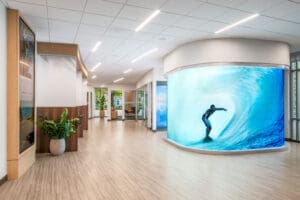
We saw a similar challenge at a smaller scale with Origin Bank’s curved LED halo in their Preston Center lobby.
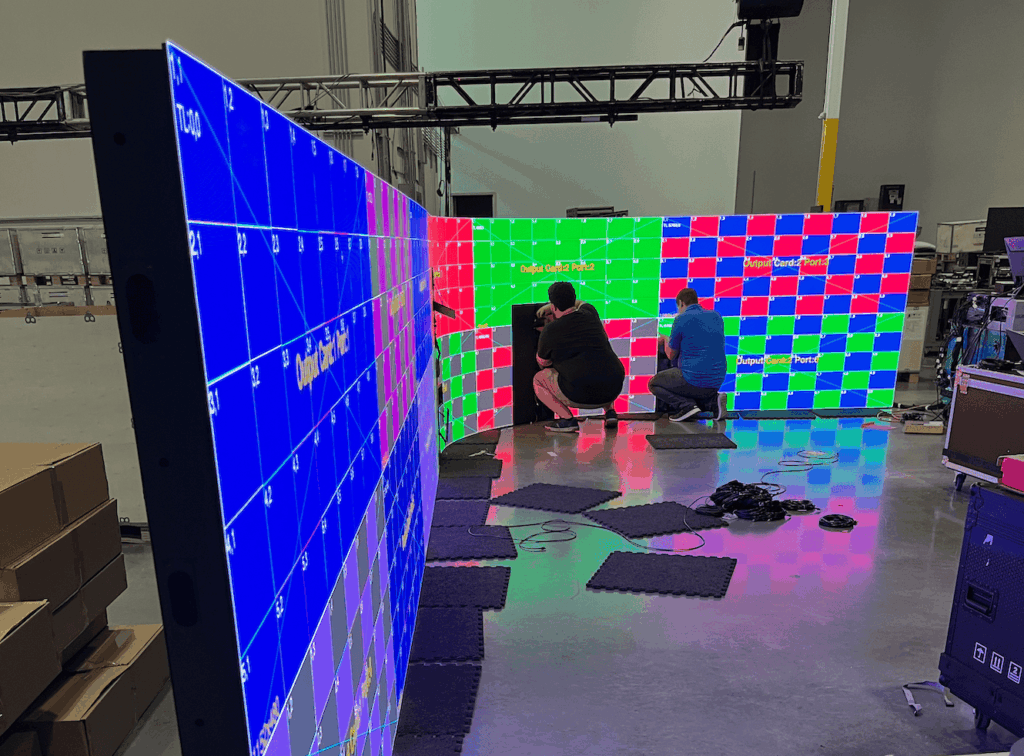
We catch tolerance issues before they become a problem in two ways. Every job includes a signed-off site-survey form specifically to make sure measurements like these don’tget missed. For more complex jobs, like an upcoming Muxwave installation at Dulles International Airport, our project manager goes onsite to work directly with general contractors and architects so minute details get logged correctly from the start. Even with that groundwork, custom conditions still come up, which is where having an experienced install team pays off. If a wall or surface needs it, our team will fabricate a solution onsite, shimming, custom woodworking, whatever it takes to create the right environment for the LED to perform at its best.
Problem 3: Content Mapping Across Angled or Multi-Surface Displays
The solution: LED handles angled and multi-surface content better than most people expect, wide diode viewing angles mean nearly every off-axis position stays covered, and purpose-built corner solutions can turn a hard seam into a seamless, even more dynamic display.
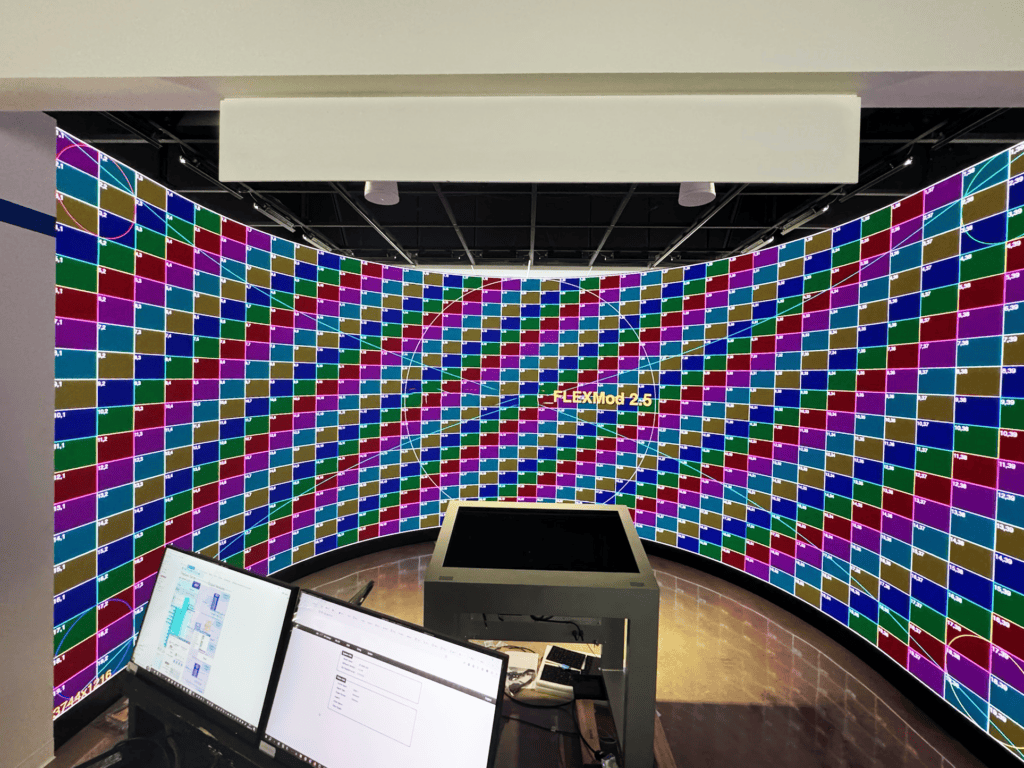
It’s a common assumption that wrapping LED content around a corner or angled surface means sacrificing image quality at wide viewing angles. In practice, most diode designs offer a 160 to 170 degree viewing angle, which means nearly every off-axis position a viewer might stand in is still covered by the diode itself.
There is some parallax effect and color shift near the extreme edges of that range, but it’s mostly negligible compared to the color shift you’d see from an equivalent LCD display.
Corners are where this gets interesting. Instead of using a mitered edge to force two flat surfaces into a 90-degree corner, our EFP and FLEXStorm VR corner design installs a true-curve module at the seam, creating a seamless transition between both faces of a building’s facade. That same design opens the door to forced-perspective content, where an image can be built to look like it’s physically emerging from the screen toward the viewer, a striking, unique way to make a building facade genuinely exciting to walk past.
Problem 4: Post-Install Repairs Without Wasting Spare Parts
The solution: When something goes wrong after an install, adhesive failure, damaged pixels, the instinct is to pull the module and swap in a spare. Often the better fix is repairing it in place, which saves both the spare and the customer’s time.
A few months after completing a Muxwave transparent LED installation, the customer reported that adhesive on some of the modules had started to fail. Around the same time, a trim technician working on a separate part of the install accidentally broke a few pixels off during trim work.
That’s two separate problems on one job, and the easy path would have been pulling modules and burning through spare parts on both.
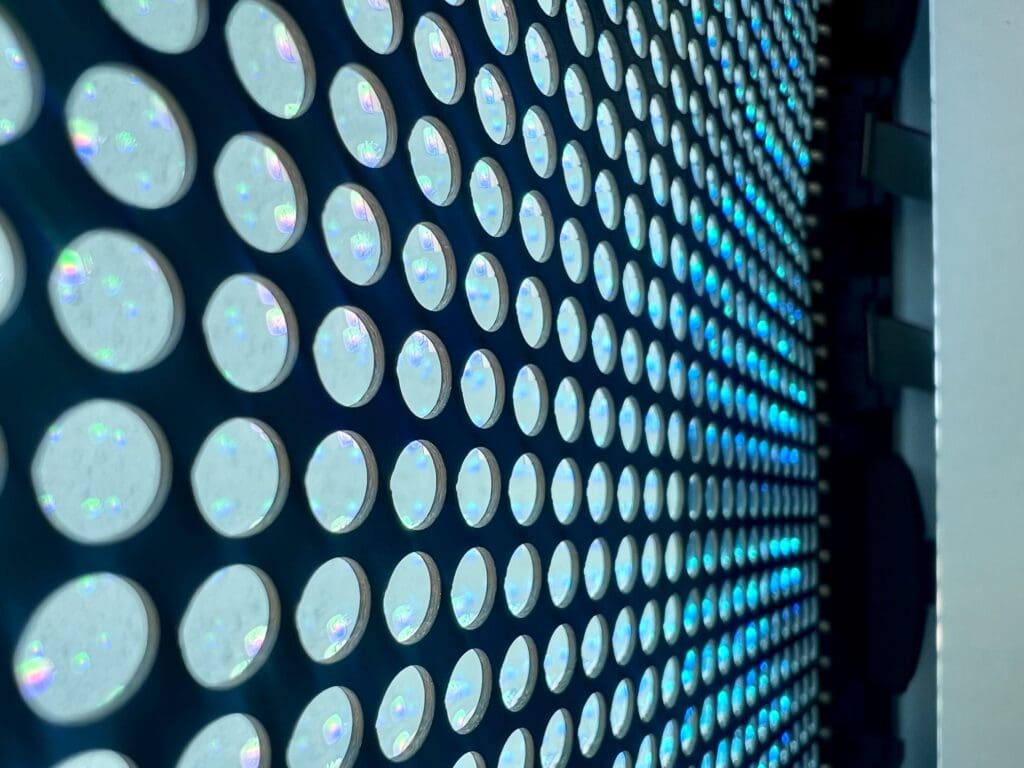
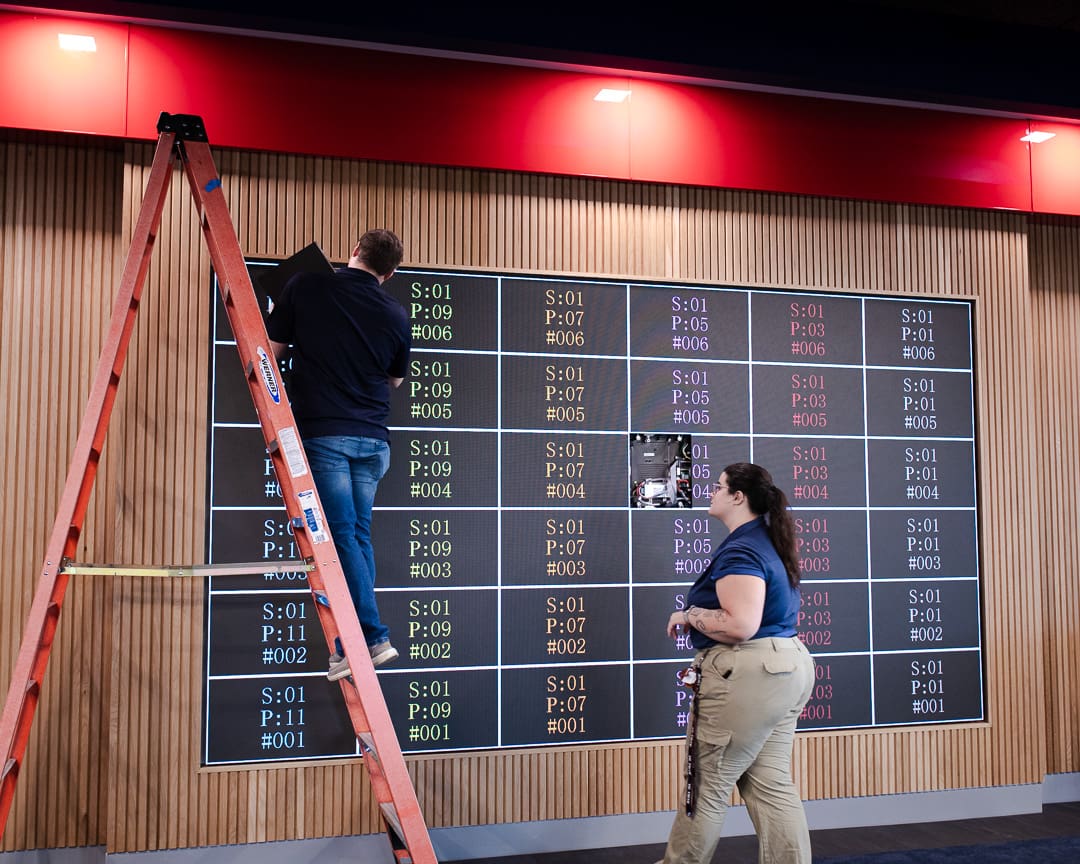
Instead, the team repaired the adhesive using a clear, UV-cured adhesive applied to key portions of the module to rebuild a strong bond, without removing the module from the glass. Removing a module to work on it actually increases the risk of further adhesive failure down the line, so keeping it in place while repairing it is usually the better call. For the broken pixels, the team relied on fine-diode soldering experience to repair them while the module stayed vertically mounted on the glass, which most installation technicians aren’t equipped to do; soldering LED diodes at that scale takes a different skill set than installation work.
Two issues, solved onsite, with zero spare modules used. A less experienced team would likely have swapped both modules, which costs the customer more in parts, shipping, and downtime than the repair itself.
Problem 5: Service Issues on an Aging Wall
The solution: A wall that’s still technically working isn’t the same as a wall that was built to last, warranty coverage, quality control, and spare parts planning up front are what determine whether a display ages gracefully or turns into a wholesale replacement project.
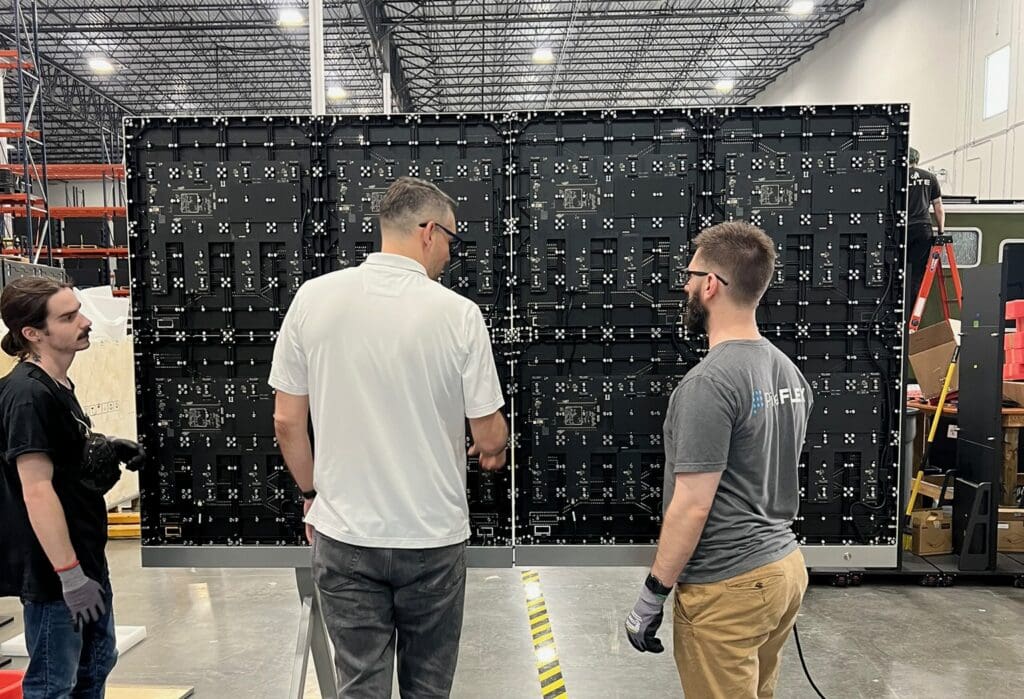
We recently began replacing a large LED installation, originally installed only a few years ago by a competitor, for a client. The LED itself is still fundamentally functioning, but the original sale didn’t include spare parts planning.
Now the customer is faced with replacing twelve working displays, not because the technology failed, but because the original provider didn’t account for the long run, they installed it and walked away.
At PixelFLEX, every installation comes standard with a 3-year warranty, with additional warranty years available. Every unit goes through a 3-party quality control process before it reaches the customer, and our team includes staff with decades of soldering experience, meaning even damaged modules can often be repaired rather than replaced. The lesson for integrators: ask any manufacturer directly what their long-term parts and repair plan looks like before you commit a client to a wall.
Frequently Asked Questions
Here are the LED display installation problems integrators ask about most
What is the biggest challenge in installing a direct-view LED display?
Structural and mounting precision are the most common challenges: the space and substructure need to be engineered around the display’s actual load and tolerance requirements, not adapted after the design is finalized.
Can direct-view LED be installed in historic or load-restricted buildings?
Yes, but it requires early coordination with a structural engineer to plan connection methods, cable routing, and weight distribution around the building’s existing constraints.
Why do curved LED installs need custom mounting structures?
A curved or wrap-around LED display needs a substructure fabricated to tight tolerances so panel-to-panel gaps don’t show through the curve; standard flat-frame mounting isn’t built for that precision.
Does LED lose image quality at wide viewing angles or on curved corners?
Not significantly. Most diodes offer a 160 to 170 degree viewing angle, and purpose-built corner modules can create a seamless curve instead of a visible seam, with only negligible color shift at the extreme edges.
What should you check before buying an LED display to avoid costly replacements later?
Confirm the manufacturer’s warranty length, quality control process, and long-term spare-parts and repair plan, displays without that planning often end up needing full replacement years early, even while still technically functioning.
Can a damaged LED module be repaired without replacing it?
Often, yes. Issues like adhesive failure or a few broken pixels can frequently be repaired in place using techniques like UV-cured adhesive and fine-diode soldering, which avoids the cost and downtime of swapping in a spare module.
Want help thinking through the structural or mounting side of your next DVLED install? We would love to connect with your team to talk through your specific space before you finalize the design. Schedule a project consultation today.